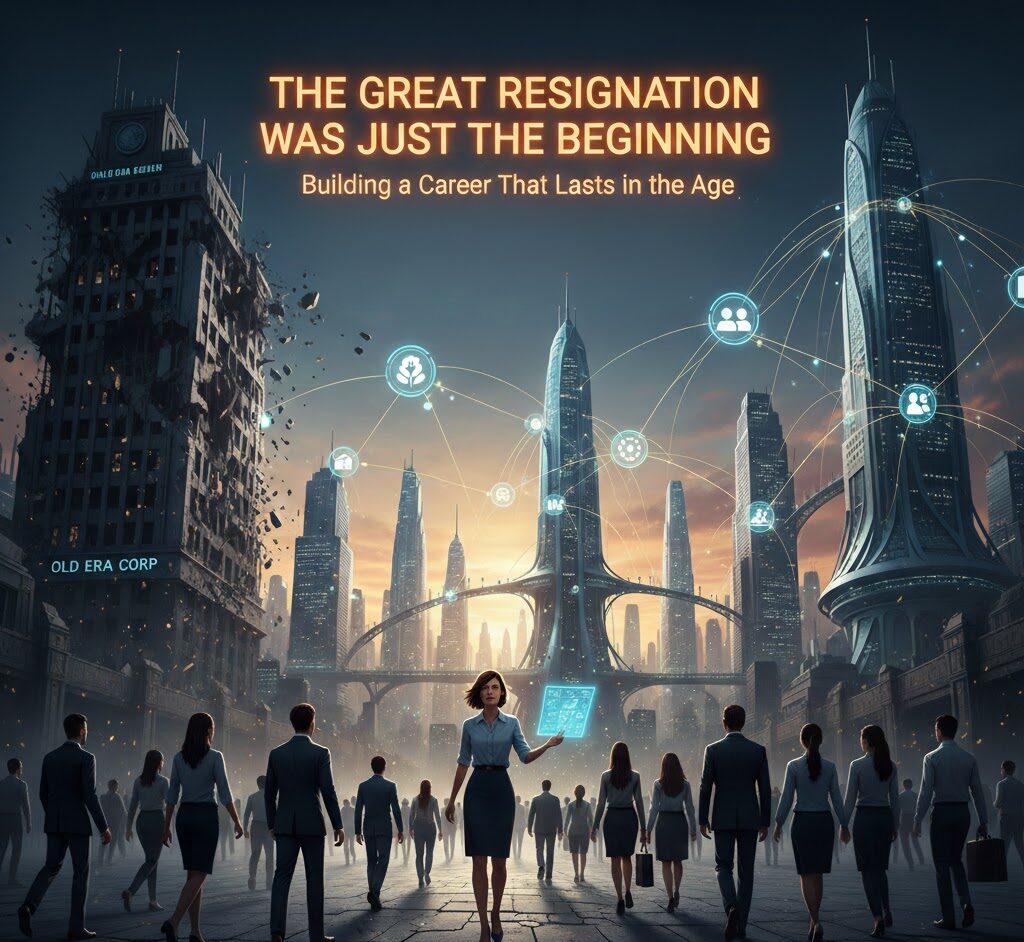
The Great Resignation Was Just the Beginning: Building a Career That Lasts in the Age
Remember 2021? The year of the “Great Resignation.” Millions walked out, tired of the grind, the disrespect, the feeling of being a cog in a machine. It felt like a seismic shift, a collective “enough is enough.” But if you thought that was the peak of employee-employer reckoning, I’ve got news for you. That was just the opening act. We’re now firmly in an era where careers aren’t built on decades of loyal service to a single company. They’re built on adaptability, continuous learning, and a smart, strategic approach to your own professional journey. The ground keeps shifting under our feet, and if you’re not prepared, you’ll find yourself struggling to stand.
The Old Playbook Is Dead, Long Live the New Game
For generations, the career path looked pretty straightforward: get a degree, land a stable job, climb the ladder slowly but surely, and retire with a pension. Loyalty was rewarded. Showing up consistently was enough. You could coast for a bit, knowing your job was safe. Those days are as good as gone.
Technology is advancing at warp speed, industries are being disrupted overnight, and the very definition of “work” is being rewritten. Remote work, hybrid models, the gig economy
these aren’t just buzzwords anymore; they’re the new reality. Companies are leaner, more agile, and frankly, less invested in a lifetime of employee loyalty. They’ll hire the best talent for the job, often on a project basis, and move on. This means the onus is squarely on YOU to manage your career, not on your employer.
What does this mean in practical terms? It means that the skills you have today might be obsolete in five years, maybe even two. It means that the company you think is your “forever job” might merge, get acquired, or simply downsize, leaving you to figure things out again. It means you can’t afford to be complacent.
That comfortable salary, that senior title – they don’t guarantee security in the long run. This is where many professionals get stuck. They believe their past successes are a shield against future uncertainty. They mistake their current comfort for long-term stability. And that, my friends, is a dangerous illusion.
The Myth of “Hard Work Alone”
Ah, the classic. “Just work harder, and you’ll get ahead.” We’ve all heard it, haven’t we? From parents, teachers, well-meaning bosses. And yes, diligence and effort are crucial. You absolutely have to put in the work. But in today’s landscape, hard work alone is like trying to win a Formula 1 race with a bicycle. It’s necessary, but far from sufficient.
What’s missing from the “hard work” equation? Strategy. Visibility. Networking. Learning to work *smart*, not just *hard*. I’ve seen brilliant, tirelessly working individuals get overlooked for promotions because they were too focused on their tasks and not on building relationships or showcasing their achievements.
They were the last to leave the office, but the first to be forgotten when opportunities arose. Conversely, I’ve seen people who are incredibly effective communicators and networkers, who understand how to leverage their efforts, rise faster, even if their individual output wasn’t always the highest. This isn’t about schmoozing;
it’s about understanding the ecosystem you work in and how to navigate it effectively. It’s about making sure your hard work is *seen* and *valued* by the right people.
Loyalty: A Two-Edged Sword in the Modern Workplace
The narrative of “ride or die” with a company for 30 years and get a gold watch is, for the most part, a relic. While there’s a certain inherent value in demonstrating commitment,
blind loyalty can be a career black hole. Companies today are driven by market demands, shareholder value, and immediate results. If your skills don’t align with their current or future needs, or if you become too expensive compared to a newer, cheaper alternative, your loyalty might not count for much.
What nobody tells you early in your career is that your primary loyalty should always be to yourself and your own growth. That doesn’t mean being disloyal or unethical. It means recognizing that your career is *your* journey. If your current employer offers opportunities for you to learn
grow, and increase your market value, then staying might be the best move. But if you’re stagnating, if the company culture is toxic, or if you’re consistently underpaid relative to your market worth, then exploring other options isn’t disloyalty; it’s self-preservation and professional development.
The real trick is to manage this balance. Be a valuable contributor where you are, but always keep an eye on your own trajectory. This includes understanding your market value regularly. Are your skills in demand? What are people with your experience earning elsewhere?
Staying put purely out of a sense of obligation can lead to significant income stagnation and skill obsolescence. Ironically, a proven track record of successfully navigating transitions and delivering value in *different* environments often makes you *more* valuable, not less.
Building Your Career Fortress: Strategies for Long-Term Stability
So, how do you build a career that can weather any storm? It’s not about finding one perfect job; it’s about cultivating a resilient professional identity. This requires a proactive, ongoing approach.
1. Embrace Lifelong Learning (Not Just for Your Current Job):
This is non-negotiable. The half-life of skills is shrinking. You need to be constantly upskilling and reskilling. Don’t just learn what’s required for your current role. Look ahead. What skills are emerging in your industry? What technologies are gaining traction? What adjacent fields might become relevant?
This isn’t just about formal courses or certifications, though those have their place. It’s about reading industry publications, attending webinars, following thought leaders, and actively seeking out projects that stretch your capabilities. Think of it as investing in your own intellectual capital. You can explore how to effectively assess your own potential and identify growth areas in my guide on Unlocking Your Potential: A Step-by-Step Guide to Effective Self-Assessment.
2. Cultivate Your Network (Authentically):
Your network is your safety net and your opportunity engine. And I’m not talking about just collecting LinkedIn connections. I mean building genuine relationships. Attend industry events (online and offline), join professional organizations, engage in online communities, and reconnect with former colleagues.
Offer help before you ask for it. Be a resource. When opportunities arise, people think of those they know and trust. A strong network can provide leads for jobs, clients, collaborations, and even honest advice when you’re navigating tough decisions. It’s about being part of a professional community, not just an individual contributor.
3. Develop “Portable” Skills:
Some skills are specific to a particular role or company (e.g., using a niche internal software). Others are transferable across industries and roles. These include critical thinking, problem-solving, communication (written and verbal), leadership, emotional intelligence, and adaptability. Focus on honing these “power skills” because they make you valuable no matter where you go. They are the bedrock of your professional identity.
4. Understand Your Value and Market Rate: This is something many people shy away from, often due to societal conditioning. But you *must* know what you’re worth.
Research salary benchmarks for your role, experience level, and location. Understand the demand for your specific skill set. This knowledge empowers you in negotiations, whether for a new job, a raise, or a freelance rate. If you’re consistently underpaid, it’s a signal that something needs to change – either your skills, your employer, or your approach to compensation.
5. Build a Personal Brand (Beyond Your Job Title):
In today’s digital age, your online presence matters. What do people find when they search for you? Are you showcasing your expertise, your insights, your passion? This doesn’t mean you need to be an influencer.
It could be as simple as consistently sharing relevant articles with your commentary on LinkedIn, contributing to industry forums, or having a professional website or portfolio. Your personal brand is how you present yourself and your value to the professional world. It’s what makes you memorable and sought-after.
6. Master the Art of the Pivot:
Careers are rarely linear. You’ll encounter unexpected turns, layoffs, or simply a change in your own interests. The ability to pivot – to change direction strategically – is a superpower. This might mean learning a new skill to move into a different role, starting a side hustle, or even transitioning to a new industry.
It requires self-awareness, courage, and a willingness to step outside your comfort zone. Think of pivots not as failures, but as strategic realignments.
Common Career Mistakes That Can Derail You
Even with the best intentions, professionals often stumble. Here are a few pitfalls to watch out for:
- Staying Too Long in a Stagnant Role: Comfort is seductive. But if you’re not learning, not being challenged, and not seeing a path for growth, you’re slowly but surely becoming irrelevant.
- Fear of Asking for What You Deserve: Whether it’s a raise, a promotion, or more challenging work, fear of rejection or appearing demanding often holds people back.
- Ignoring “Office Politics”: While I advocate for authenticity, ignoring the human dynamics, the informal power structures, and how decisions *really* get made is naive and detrimental. Learn to navigate it ethically.
- Neglecting Your Personal Finances: A stable career also means financial resilience. Not having an emergency fund or being buried in debt puts you in a vulnerable position if your income is disrupted.
- Burnout as a Badge of Honor: Glorifying overwork is a fast track to exhaustion and diminishing returns. Sustainable high performance is the goal, not constant sprints ending in collapse.
The Modern Workplace: What’s Different in 2025-2026?
The pace of change hasn’t slowed. If anything, it’s accelerating. Here’s what’s shaping the professional landscape right now:
- AI Integration: Artificial intelligence isn’t just a buzzword; it’s becoming embedded in workflows across industries. Professionals who can work *with* AI, leverage its capabilities, and focus on uniquely human skills (creativity, strategy, complex problem-solving, empathy) will thrive. Those who resist or whose jobs are purely automatable face a serious challenge.
- The Hybrid Reality: The debate about remote vs. office continues, but the reality for many is a hybrid model. This requires new skills in communication, collaboration, and self-management to ensure productivity and maintain team cohesion across different working arrangements.
- Focus on Well-being: Post-pandemic, there’s a greater emphasis on mental health and work-life balance. Companies that genuinely support employee well-being will attract and retain talent. Burnout is no longer seen as just an individual problem but a systemic one.
- Gig Economy Growth: More professionals are exploring freelancing and contract work for flexibility and autonomy. Building a reputation, marketing yourself, and managing diverse clients are becoming essential career skills.
- Data Literacy for All: Whether you’re in marketing, HR, or engineering, understanding and interpreting data is becoming a foundational skill.
Your Career Future: Evolving or Extinguishing
The future of work isn’t about predicting specific job titles. It’s about cultivating a mindset and a skill set that allows you to adapt to whatever comes next. Your career will likely be a series of projects
roles, and learning experiences, rather than a single, lifelong ascent within one organization. The ability to learn, unlearn, and relearn will be your most valuable asset. Your reputation for reliability, innovation, and integrity will be your currency.
The professionals who succeed will be those who see their career not as a destination, but as a continuous journey of growth and contribution. They understand that stability comes not from the job security of yesterday, but from their own enduring capability and adaptability. It’s a more challenging path
perhaps, but infinitely more rewarding and secure in the long run. It’s about building a career that’s antifragile – one that actually gets stronger when faced with adversity. That’s the real goal, and it starts with the choices you make today.
Q1: How do I know if my current job is actually hurting my career growth?
Look for red flags: lack of new learning opportunities, no clear path for advancement, repetitive tasks that don’t stretch you, feeling undervalued or invisible, and a general sense of boredom or dread about going to work. If your skills aren’t evolving and the company isn’t investing in your development, it’s a strong signal to start looking elsewhere.
Q2: I feel like I’m too specialized. How can I become more adaptable?
Identify the core transferable skills within your specialization. For example, if you’re a data analyst, your core skills might be problem-solving, analytical thinking, and communication. Then, actively seek out opportunities to apply these skills in slightly different contexts, or take courses to broaden your knowledge base in related areas. Networking with people in adjacent fields can also open your eyes to new possibilities.
Q3: Is it too late to change careers if I’m in my late 30s or 40s?
Absolutely not. Your experience is a huge asset. Often, a career change at this stage is about leveraging existing skills and applying them to a new domain, or building upon your expertise with a new focus. It requires honest self-assessment and a strategic plan, but it’s very achievable. Many people find their most fulfilling careers in their later professional years.
Q4: How often should I update my resume and LinkedIn profile?
Ideally, you should keep your resume and LinkedIn profile updated as you achieve new milestones, complete significant projects, or acquire new skills. Don’t wait until you’re actively looking for a job. A regularly updated profile ensures you have an accurate and compelling representation of your professional journey ready at all times. Think of it as ongoing maintenance, not a one-time renovation.
Q5: What’s the best way to build a professional network without being pushy or fake?
Focus on genuine connection and offering value. Instead of asking for favors, ask thoughtful questions, share relevant insights, and offer your help or expertise when appropriate. Attend industry events with the goal of learning and meeting people with shared interests, not just collecting business cards. Engage meaningfully in online communities. People are more likely to reciprocate genuine helpfulness.
Q6: How can I balance staying loyal to my employer with looking out for my own career interests?
This is about informed commitment. Be a dedicated and valuable employee. However, stay informed about your market value, industry trends, and your own career aspirations. If your current role aligns with your growth and you feel valued, stay. If not, it’s responsible to explore opportunities that better serve your long-term professional development. True loyalty is built on mutual benefit, not just obligation.
Q7: With AI becoming more prevalent, should I be worried about my job security?
Worrying won’t help, but preparing will. Focus on developing skills that complement AI, rather than compete with it. This includes creativity, critical thinking, emotional intelligence, complex problem-solving, and strategic decision-making. Learn to use AI tools effectively in your role. The future belongs to those who can harness technology and bring uniquely human capabilities to the table.